
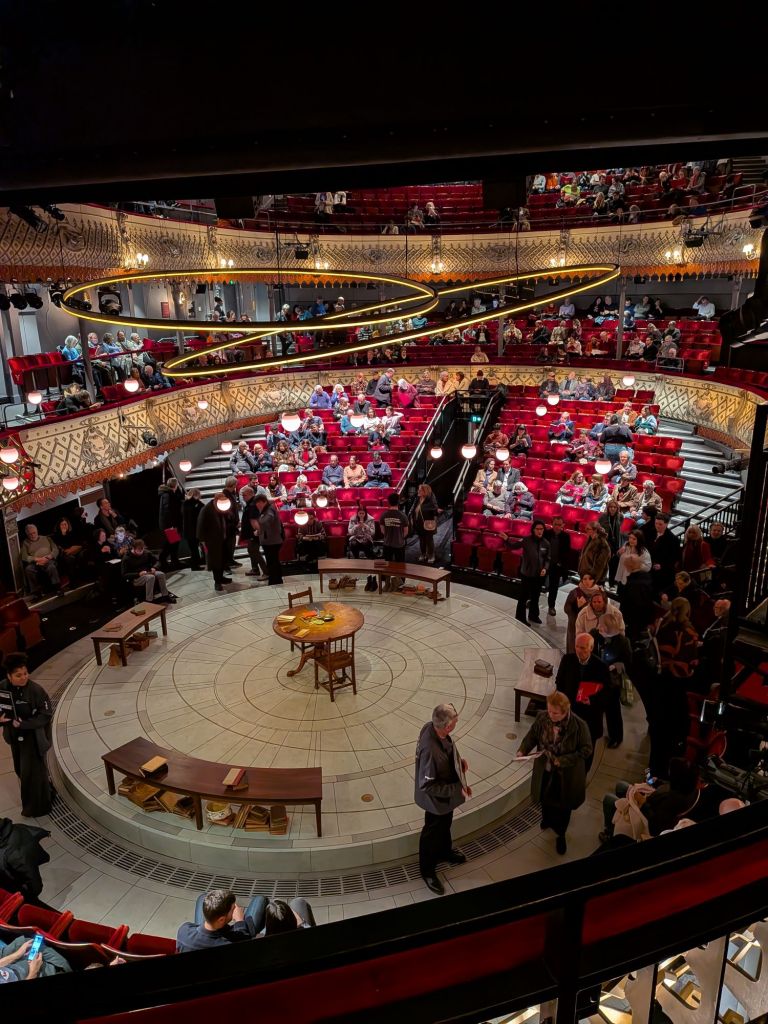
Tom Stoppard died in December, which will surely have increased interest in the production of Arcadia opening at The Old Vic in January. I had forgotten what a plush venue it is, with very nice carpets, lots of bars, space and staff. Most theatres in the West End feel incredibly cramped, where you join the dust bunnies in the corner to drink a stingy gin & tonic before queuing forever for the two Ladies’ cubicles.
My sister gave us the tickets as a Christmas present, meaning babysitting was part of the present. As usual it ended up coinciding with unexpected activities, in this case a hockey match and a birthday party, so I felt a bit guilty.
People at work asked me what the play was about, which I think is part of why Tom Stoppard is so popular – all his plays are about everything, and every viewer applies them in myriad different ways.
It is about the passing of time and individuality, and the futile attempt of any appeal to rationality in the face of love. The narrative takes place in the 1990s present, and in 1809, in the same stately home, which is inhabited by members of the same family, and their coterie, in both eras.
A lot of the marketing presents it as a comedy, but it is hardly a play of light-hearted hilarity; there are a few witty one-liners to lighten the tone and underline the parallel threads of meaning for the main character, Septimus Hodge. The central speech concerns the paradox he sets out between his belief that everything is repeatable, that nothing is every truly lost to time, because humans will keep reinventing and rediscovering, and his observation that since time is one-way, we can never recreate exactly the same moment. In the present, his analogue character discusses the fact that coffee can only ever get cold on its own, not hot. The whole narrative of scientific discovery that threads through the play is a metaphor for what is lost when individual lives are lost.
What I was thinking as I was watching it was what AI means for any human discovery, and how Hodge’s comforting speech about putting the loss of the library of Alexandria into context is negated by what we have lost in the internet. Hodge brushes off the destruction by observing that although we don’t even know what was lost, we retain enough of the output of Euripides to delight us. I often feel as if we no longer retain enough of anything, and more importantly, are losing the ability to create anything novel at all. Our phones are where are brains go to die, and sometimes I feel that we are already at that point he describes where we have
“discovered all the mysteries, and lost all the meaning”.
He describes this as reaching an empty shore, which it often feels as if we have. When I read all the AI slop that covers the internet, I feel bored and sad for all the minor talents of writing or design that will never be able to scrape a living.
The true leaders of their field will be unaffected, and if anything will receive a concentration of our attention. I don’t know how the writers of the future will ever become leaders, if everyone believes they can be a jack of all trades. It’s quite interesting to read about the creative process of famous screen writers, who are quoting a timeline of over a year before they will be finished with Season 2 of their show. For all the LLMs churning out many thousands of pages, emotional meaning of that level of complexity (because conveying emotion through fiction on a screen is incredibly complex) is still only conveyed from human to human.
Richard on the other hand, in his current fragile state of permeability between memories and the present, took away all sorts of quite mystical things from the play. I have rarely seen him so animated, talking about how much it took him back to his teenage years; I think he was referring to that moment that must be some sort of developmental stage, where you can almost feel your mind expanding, where everything feels like an epiphany of sorts, and the world is new and fresh and exciting. He said it reminded him of school, and he texted his school friend at great length. I think the fact the play was first written in 1993 does come through in the text, and the staging places it quite deliberately in its time, with the now-ancient laptops underlining how the process of renewal continues.
I took away a less optimistic view, because I was entirely focussed on the tragic love story, but perhaps Richard (and the production staging) is right, we should focus on what we retain and create.
 The resting writer
Leave a comment