
Whenever anyone asks me what my best job was, it is without hesitation that I say waitressing. I worked in a large traditional cafe-brasserie with a terrace, in the middle of touristy Heidelberg, in Southwest Germany which is mainly populated by American tourists, as well as pretty much every other nationality. The Americans stood out, because most of my degree was funded by Americans.
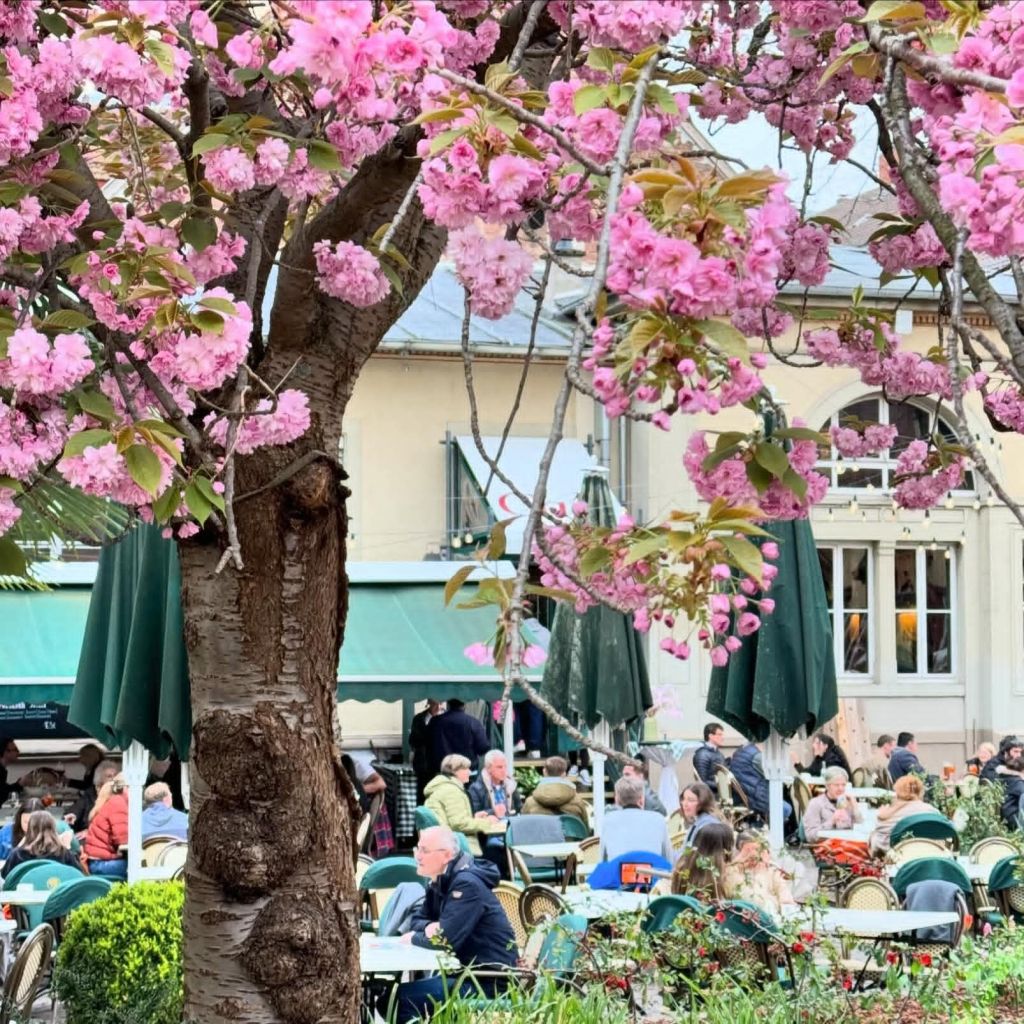
Waitressing was demanding, if not necessarily hard. I prided myself on memorising all the till codes for every item on the menu, because it made entering the orders so much faster. I see till machines nowadays, with descriptions for everything, and it makes the menu big and unwieldy. It’s much faster to just have a keypad and three numbers for every item, and it does give anyone with a good memory an edge. In waiting tables, the faster you can perform every task, the more money you can make. The better you are at appearing completely in control and not going too fast, the more money you can make. The more you share tips with the kitchen, the more you will make. These were all valuable things for me to learn, although I didn’t get the bit with the kitchen right first time.
I made friends with the other waitresses my age, who were sisters. Their father worked as the dishwasher. He filled me in on why my orders kept disappearing, resulting in the learning experience about incentives. Many of the staff had worked there for many years. They took their responsibilities seriously, and would help us student interlopers manage difficult customers.
It was 1999, and I remember one day when the solar eclipse happened, and we all got the glasses out and watched. It was somehow really great standing there with the whole team, and all the customers. There was no minimum wage in Germany, but I didn’t earn as much money again until at least 2004. I was paid 10 DEM per hour, until I reached a turnover of I think 1000 DEM. At that point, I was eligible for 10% revenue share in lieu of an hourly rate. I think the most I turned over in a day was 2500, which netted me 250. All tips were also mine to keep, or make a wise investment in funding the supply chain.
The other students working there were studying business management, and molecular biology with genetic engineering. I always imagined the biology guy going on to do some cool stuff with genetic engineering, but it turns out he now works in food safety. I’m sure it’s a good job. There were also some medical students, but they seemed weirdly flaky and left quite quickly. One of them t was the source of the biggest customer issue I saw, where she spilt an entire bowl of soup on a customer and he marched in threatening to sue (she was so slow it wasn’t actually that hot). People always think Americans are the most litigious, but Germans are pretty keen.
I spent three summers working there full time, usually from 12 pm until past midnight, when we would have a few Feierabend shots and go out to a club with the Lebanese girls until 4 am. I worked as many days as I could. As a 22 year old, there was no better job. I’m sure I should have been polishing my CV with some internships, but I didn’t really want to sit in an office, which I was going to do for the rest of my life. The pay was roughly the same, and I didn’t have anywhere to stay in London anyway, so it seemed hard to organise. Oxford terms were very short, so I had earning opportunities for almost half the year. I also worked on translations, in a geese packing operation, and a circuit board factory, which were not quite such good jobs.
One of the reasons I loved waitressing is that I love negative feedback. This may seem surprising in the context of my 48 year old self having a minor hissy fit at getting corrections from a highly competent professional violinist, but I think the reason the incentive of tips, and their withholding, works for me is that the difference between good service and bad service is not that subjective. If the customer thought I’d done a bad job, I mostly anticipated that, and in some cases it was quite a calculated profit maximisation strategy. The way to make more money was to serve Americans first, second and third, and everyone else last. If you had 10 tables show up at the same time, you looked for the Dutch group, and did as little as possible for them. Input effort would result in exactly the same zero-tip, so they got attention after I had made sure my other customers were happy. Americans would vary their input quite satisfyingly between 10% and over 20%, and even if they weren’t super happy (10%), they were gracious and polite. You could spend 2 hours turning over 200 marks on a large table of Dutch people, and they’d ask for change from 199.50.
The usual tipping culture in Germany was to round up any odd amounts to the nearest full number, and for larger orders, to the nearest 10. So the margins tended to decline the larger the order was, which is why it was very important to keep on top of coffees and drinks. The proportion of tips on small orders is huge; a 3.40 coffee will attract a rounded-up 4.00 almost automatically, so I was very focussed on regulars and single tables, who would be very likely to order just drinks.
I learnt so much about people, and what people will dare to say. I had one old lady who complimented my very German looks, and then muttered something about Hitler. I kind of smiled vaguely and walked away. In your head, you think you’ll challenge people and hold them to account, but if you work in customer service, you learn to let things flow over you a little more.
In other jobs and other skills, the path to satisfaction is so much less clear. My customers change their minds, they don’t care how good the thing was that they asked for last week. You’re only as good as the last thing you did. When you’re trying to improve a skill as hard as the violin, it feels like chance as to whether you will perform to the best of your ability. This is mainly because massively complex skills need so much training and constant practice to maintain and grow. It is quite similar in more complex professional roles, where the number of variables is too large, and many of them are outside my control – meaning I can’t necessarily trace a clear path as to how I’ve made money for the company. The quality of service in hospitality is at least 50% of the experience, so aligning incentives to ensure consistent quality is a measurable bottom line outcome. Delivering good software is massively complicated by the fact there is often no menu, and therefore making customers happy with their software meal feels very precarious.
It matters to maximise quality, but tipping and profit share incentives are designed to improve customer experience and turnover, not to reward people for doing their jobs. This is also why I am these days so completely outraged by the ludicrous tipping culture in which tips are either added to the bills, or you see these hilarious signs about how if you can’t afford to tip 25% on a $200 bill, you can’t afford to go out. That is not how it should work. Servers are not paid nothing, and even in the US, they do have a minimum wage. There are many other minimum wage jobs that attract no tips at all, and are much less pleasant. I often wonder whether societies that don’t tip at all are more interested in equality of effort than in outcomes. Working in a circuit board factory is noisy, dusty and very boring, and has no chance at all of any perks – whether tips, free food, drinks or any of the other things that tend to happen in hospitality. Factory work is better paid, but by nowhere near as much as it loses in life happiness. Providing tips only to workers you see seems to denigrate the hard work of the many people on whose labour we depend to a much greater extent.


Leave a Reply